
Twenty years of fieldwork.
Now a platform.

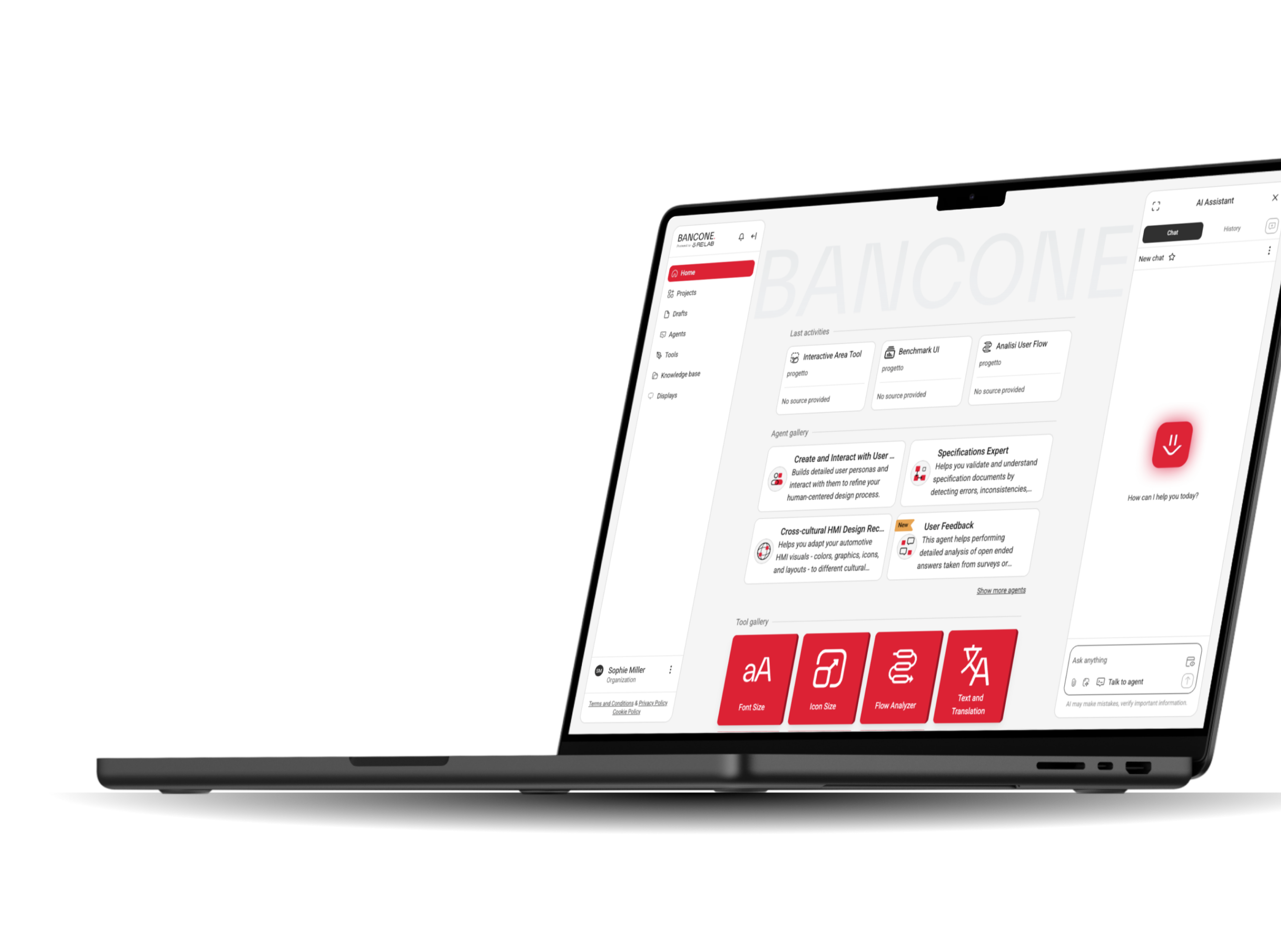
RE:LAB has spent two decades inside cockpits, medical devices, automotive dashboards, and control rooms, learning what makes an interface dangerous, confusing, or just hard to use. BANCONE is how RE:LAB transforms that knowledge into operational support—integrated directly into your design workflow—adding expertise where needed and amplifying your team’s existing capabilities.

The Lab behind
BANCONE.

Founded in 2004 in Reggio Emilia, the heart of Motor Valley, RE:LAB is an Italian Interaction Engineering company. With more than 140 employees across four offices in Italy, it works with clients across industries and international markets, bringing together expertise in design, human factors, ergonomics, and engineering.


Every dimension
of the design process.

From concept to compliance, from usability to perceived quality. BANCONE automates repetitive tasks and refines design decisions with algorithmic precision, covering the full spectrum of interface and product design: usability, legibility, accessibility, localization, standards validation, and test case generation.


Four pillars
One integrated platform.

Each built for a specific type of work, BANCONE’s pillars are designed to operate independently or in combination.


Built into Figma.
Active as you design.

The native Figma plugin of BANCONE checks legibility, ergonomics, and standards compliance in the same environment where design decisions are made — based on real user needs, on the principle that validation has to fit the process to avoid useless iterations.

Text & icon sizing
Text and icon sizes validated against industry standards, based on screen resolution and viewing distance

Interactive area validation
Touch target sizes and spacing verified against ergonomic requirements, with automatic conflict resolution

Interaction flow analysis & UI benchmarking
Task completion times estimated for specific UI flows using standardized HMI methodologies

Translation fitting & Multilingual localization
Content translated in more than 30 languages, generation and text fitting validation directly in Figma

Icon set consistency
Full icon system evaluated for visual coherence, cultural appropriateness, and legibility

More tools in development…

See BANCONE in action.

Book a demo with the team and see the platform applied to use cases from your domain.
If you want to go further, we also run workshops to co-design custom agents and tools around your specific workflows and processes.


Flexible plans for every need.

BANCONE goes beyond teams and organizations, adapting to specific fields.
A dedicated license for education, configured around a different set of needs, methods, and goals.


Specialized by design.

Choosing BANCONE means having domain expertise, organizational knowledge, and validated workflows in one place. A platform that understands the standards your interfaces need to meet, learns from your own guidelines, and delivers outputs your team can act on immediately.

Why choose BANCONE.

Vertical domain expertise (HMI, UX, Human Factors)

Native Figma integration

Organizational knowledge base

Data privacy & security guaranteed

Co-developable agents, tailored to your needs

Methodology-aligned workflows

Customized platform for your needs

Shared projects, tools, and role-based access


For Universities, Design Schools
& Academies.

Choose the plan that fits your workflow and team size, whether you’re managing a compact project team or coordinating multiple departments in a structured organization.


Got Questions?
I’ve Got Answers.

What does the BANCONE means? 

BANCONE draws its name from the Italian word “BANCONE”, which refers to a counter, workbench. This name was strategically chosen to reflect our platform’s core function as a comprehensive workbench for HMI design and development.
In Italian, a “BANCONE” is where skilled professionals craft their work with precision and expertise—whether it’s a craftsman’s workshop or the counter where a barista creates the perfect espresso. Similarly, our BANCONE platform serves as the digital workbench where teams craft exceptional HMI experiences. Behind the BANCONE, RE:LAB’s long standing expertise and knowledge base is at work. 

What do we refer to with HMI and HMI assistant? 

HMI (Human-Machine Interface) refers to the system that allows users to interact with a machine, device or software. In the context of User Experience (UX) and User Interface (UI) design, HMIs are commonly found in vehicles, industrial equipment and digital interfaces, providing users with controls, displays and feedback mechanisms to operate and monitor systems efficiently.  
An HMI Assistant is an intelligent tool designed to support designers, prototypers, researchers, and validators by automating key tasks related to HMI development and evaluation. It helps analyze interface designs, improve usability, ensure compliance with guidelines, and streamline testing processes. By leveraging AI, the HMI Assistant reduces manual workload, enhances decision-making, and accelerates the design and validation of user-friendly interfaces.

How does BANCONE compare to traditional HMI development tools? 

BANCONE serves as an intelligent assistant throughout the entire design, development, and validation lifecycle, unlike traditional tools that segment these phases and focus on individual implementation activities. Its AI capabilities seamlessly automate routine tasks, provide real-time feedback, and enable predictive testing across all phases, resulting in faster development cycles and higher quality outputs.

What makes BANCONE different from general-purpose LLMs? 

BANCONE builds on the capabilities of the most advanced LLMs, but it’s not a simple chatbot — it’s a complete work environment. The platform brings together AI-powered chat, specialized tools, Figma integration, and task-specific agents, all designed to support your actual workflow. What truly sets BANCONE apart is the control it gives you. You decide when to allow BANCONE to access your analyses’ results and work on it. You pick which agent to interact with, enabling its capabilities only when you need them. And you can shape BANCONE’s knowledge by uploading your own methodologies, guidelines, and datasets. In short, BANCONE turns LLMs into operational tools that integrate seamlessly into your work environment — while keeping you in full control. 

Which applications does BANCONE integrate with?

BANCONE integrates with Figma through a dedicated plug-in that lets you work directly within your design environment. The plug-in is seamlessly connected to the BANCONE web app, so all analysis results generated inside Figma can be accessed and queried directly within BANCONE — leveraging its AI agents and your knowledge base. This means you can move fluidly from design to analysis without leaving your workflow.
Further integration with other tools will follow soon.